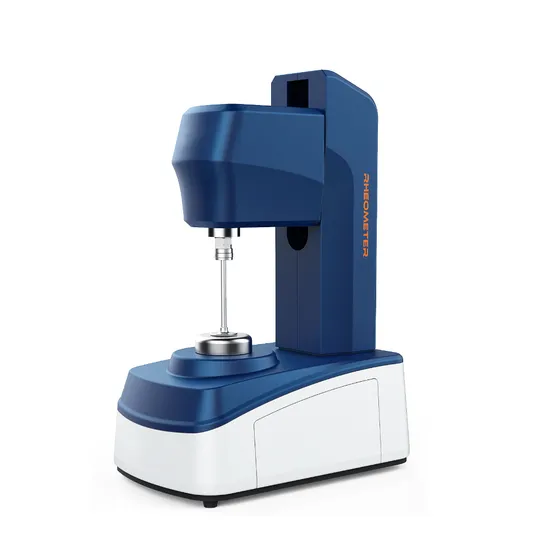
Rheometer Food Drug Chemicals Analysis Instrument
| US$50,000.00-100,000.00 | 1 SET (MOQ) |
Basic Info.
Model NO.
RHM-20
Rotor
Air-Driven
Accessories
Cone Plate, Flat Plate, Axial Cylinder
Test Material
Food, Drug, Chemicals, Cosmetics
Category
Physical Property Test
Transport Package
Wooden Case
Specification
RHM-20
Trademark
SRI
Origin
China
HS Code
9031809090
Production Capacity
200sets/Month
Packaging & Delivery
Package Size
20.00cm * 20.00cm * 40.00cm
Package Gross Weight
8.000kg
Product Description
Product Description The Rheometer is specially used to measure the rheological properties of polymer melt, polymer solution, suspension, lotion, paint, ink and food. It is divided into rotary rheometer, capillary rheometer, torque rheometer, and interface rheometer.
The Rheological performance measurement serves as a bridge between the molecular weight, molecular weight distribution, branching degree, and processing performance of polymers, providing a direct connection to assist users in raw material inspection, processing process design, and predicting product performance.
Features Air-driven rotor
Normal force sensor
Optical coder
Speed fully controlled in digital
Easy to learn and operate, durable, safe and reliable;
User defined operating procedures to meet user specific testing needs;
Automatic testing can be achieved without computer connection;
Automatic speed and temperature control ensures the accuracy and repeatability of the results;
Automatic calibration function makes the calibration process simple and fast;
Applications Oil drilling mud inspection
Rheological properties of biodegradable materials
Asphalt performance evaluation
Thixotropy experiment of waxy crude oil;
Rheological properties of colloidal liquid foam;
The rheology of low-temperature gel type plugging agent solution.
Product Parameters
| Minimum torque | 5nNm |
| Maximum torque | ≥ 200 mN. m |
| Torque resolution | ≤ 0.1 Nm |
| Motor inertia | ≤ 12 μ Nms |
| Angular displacement resolution | ≤ 15 nrad |
| Oscillation frequency | 10-4 Hz~100Hz |
| Maximum normal force | 50 N |
| Electric heating concentric cylinder temperature range | room temperature -300 ºC |
| Liquid temperature control concentric cylinder temperature range | -30-200 ºC |
| Maximum speed | ≥ 4500 rpm |
1. Flow curve of dispersed liquid
The following figure shows a typical dispersion flow curve. Rheology only obtains the flow curve by applying stress (or shear rate) and measuring shear rate or stress, or by steady-state experiments, measuring a viscosity at each equilibrium constant stress to obtain the flow curve. From this, information on yield stress, viscosity, shear thinning, and thixotropic loops can be obtained, which is related to various phenomena in the real world.
2. Flow curve of polymers, study on rheological properties of polymers, viscoelasticity
2.1 Flow curve of polymers
This figure shows the typical flow curve of polymers and the corresponding shear rate range of the process. The molecular weight of polymers has a significant impact on viscosity, and the molecular weight distribution and branching degree have a significant impact on the shear rate dependence. This difference can only be reflected at low shear rates, and the adhesion index and capillary rheometer are powerless. The RHM-20 rheometer can analyze molecular weight and molecular weight distribution through viscoelastic properties and flow curves, while the Cox-merz law and TS law can extend the data to higher shear rates.
2.2 Rheological properties study of polymers
2.3 Viscoelasticity
The viscoelasticity of polymers is usually measured using a dynamic oscillation mode. The following figure shows the viscoelastic curve (main curve) of a linear polymer, representing the changes in elastic modulus G and loss modulus G. Due to the viscoelasticity of polymer melts and the time-dependent mechanical response, they correspond to long-term responses in the low frequency range. TTS can be used to expand data to high and low ranges. The shape and size of G and G "are related to the molecular structure of polymer.
3. Strain-scan mode
Test key viscoelastic parameters (G, G °, n, Tan6, etc.) in oscillation mode as functions of stress, strain, frequency, temperature, and time. The following figure shows the starting point of nonlinear viscoelastic behavior determined using dynamic strain scanning. In the linear viscoelastic region Within the LVR range, the material exhibits a linear response to applied stress or strain, with the elastic modulus G and loss modulus G independent of strain. The internal structure of the material remains intact under linear testing conditions. Beyond the linear viscoelastic range, the material's response is completely nonlinear. The dynamic modulus G and G ° rapidly decrease with increasing strain and undergo modulated stress. Under high strain testing conditions, the internal structure of the material is completely destroyed. In the nonlinear zone, the material's response is completely nonlinear Rheology analysis using wave modulation is called "Fourier rheology".
4. Creep and stress relaxation
In the creep recovery experiment shown in the figure below, a constant stress is applied to the sample, and the strain generated varies with time. Subsequently, the stress is relieved, and the recovery strain is measured. For polymer melts, zero shear viscosity and equilibrium recovery flexibility can also be obtained. The RHM-20rheometer is a very suitable and sensitive method for measuring creep performance. The stress relaxation experiment involves applying strain to a sample, measuring the subsequent changes in stress over time, and measuring the stress relaxation modulus G (t).
5. Stress and shear rate scan
The stress and shear rate scanning experiment is the most widely used state experiment to easily and quickly determine the yield stress and thixotropic behavior of materials. These two phenomena are time-dependent behaviors of typical structural fluids and can help understand the performance in material applications. Stress scanning is a typical method for testing fluid stress in structures. The stress changes linearly with time, while recording the transient viscosity of the strain. As shown in the figure below, the viscosity initially increases and then reaches its maximum value. The surrounding point of the stress value at the maximum viscosity is the yield value. After exceeding the maximum value, as the stress increases, the structure of the material is destroyed, and the witherness decreases or the shear becomes thinner. Shear rate scanning is commonly used to investigate thixotropic behavior, and the testing process includes the process of shear rate from zero to the final rate and returning to zero, which forms a thixotropic loop. The magnitude of stress during the descent process is lower than that during the ascent process. The ascent and descent curves are functions of the shear rate, known as the thixotropic index.
6. Stress growth experiment under transient step rate
For the rheometer, the most challenging rheology test is to measure the transient viscosity and the first normal force coefficient of a viscoelastic material using a cone plate. The instrument must have a very low axial flexibility to minimize secondary flow that affects the normal force. Rheology only uses high axial hardness air bearings and non yield force rebalancing sensors to reduce axial motion, with a maximum flexibility of only 0.1um/N. The following figure shows the results of a series of step rate tests, with shear rates ranging from 0.1-100S-1. From these results, it can be seen that the rheometer can easily handle challenging experiments. At all shear rates, the transient viscosity and the first normal stress difference coefficient overlap well in a short period of time. As the viewing time increases, at the shear rate, the nonlinear response of the material leads to the separation of viscosity and normal stress difference. The overshoot of viscosity and first normal stress difference coefficient is caused by the internal structural changes of the material under strong shear.
7. Dynamic Mechanical Testing of Solid Torsion
The rheometer can study the viscoelastic properties of solid materials through solid torsion. The figure below shows the viscoelastic characteristic curve of carbonic acid (PQ). The transformation and relaxation of molecular chain segments show step changes on the elastic transverse star curve, and the loss peak appears on the loss modulus curve. The size and shape of the elastic modulus G, loss modulus G, damping factor (Tan) curve are related to the chemical composition, crystallinity, molecular structure The degree of crosslinking is related to the type and content of the filler.
Company Profile
>> Tepps Industrial Automatic Medical Masks Clothes Socks Filling Sealing Packaging Machine Sealer
>> Front Axle High quality wheel hub bearing repair kit 96285525 for CHEVROLET DAEWOO
>> 90kw PVC Card HDPE Pet Plastic Bottle Shredder Recycling Machine for Plastic
>> Livestock Feed Machine Poultry Feed Making Machine Chicken Feed Pellet Mill Machine
>> M12 Self-Anchoring Expansion Concete Wedge Anchor Bolts
>> 500L Fruit Juice Production System/Stainless Steel Blending Tank/ Electric Heating and Cooling Tank
>> Outdoor Waterproof Camping Tent Foldable Family Picnic beach Tent
>> China Jwz-Bm 1000L Single Face Pallet Blow Molding Machine Making Mavhine
>> Ultimate White Shoe Stain Remover with Anti-Fog Protection Formula
>> China Sanny Sy265h-S Engine Power 150 Kw Bucket Capacity 1.6 Cbm Cumins Qsb6.7 Best Medium Size Crawler Excavator for Sale
>> High quality Front Hood Gas strut for Mercedes Benz W203 CL203 S203 2000-2011
>> Small Mixing Capacity New Mobile Auotomatic Feeding Mixer 0.7 Cbm Concrete Mixer for Construction
>> Agricultural Machinery Harvesting Equipment Mini Farm Tools Potato Peanut Sweet Combine Harvest for 20-120 HP Farm Mini Tractor
>> 4508 Professional Compact Tapping Automation Machine for High-Performance Dental Tasks
>> Large Output Multy Function Cleaning Machine
>> Smart horseshoe lock APP applet unlocking Bicycle lock Bicycle lock Remote unlocking
>> DN15-DN300mm sandwich Ultrasonic Smart Water Meter
>> Gurki Hot Sell Automatic Box Packing Machine Sealer Carton with Long Service Life
>> Showstopper Clear Crystal Spotlight Trophy Award
>> Automatic drinking pure water/milk/juice pouch sachet filling packing machine price
>> Heavy Construction Machinery Hydraulic Crawler Excavator Ze245 for Sale
>> Desktop Sff 7.5L Computer Case, Tfx Power Supply Supported, PC Case
>> 100% Original Model 2 3 4 Buttons Remote Replacement Car Key Blank Car Key Shell for Toyota Corolla Camry Matrix Yaris RAV4 Key Toy43
>> Hot Press Turbo Segment Diamond Cutting Saw Blade for Tile Ceramic Concrete
>> Insulated Fire Rated Aluminum Material Clip-in Ceiling Acoustic Sound-Absorption Ceiling
>> CNC Inclined Bed Lathe Machine Bck520 High Quality CNC Lathe Machine
>> Cosmetic Soft Tube Heading Machine Soft Tube Injection Heading Machine Plastic Soft Tube Heading Injection Moulding Machine
>> High Quality 2ton 3 Ton 4tons Customized Railway Crawler Digger Bagger Excavator
>> 1810684M92 Repair Kits for MF Tractor
>> High productivity 4 lane small 5g 10g sugar bag packaging machine sugar sachet packing machine sugar stick packing machine